
APARTMENTO MAGAZINE
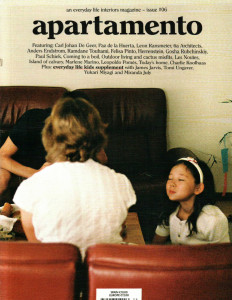
Issue 6, Autumn/Winter 2010-2011
Charlie Koolhaas contributes a feature of her photographs and writing about her studio in Guangzhou, China
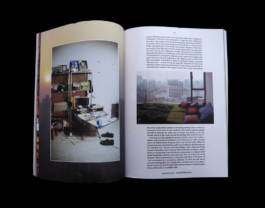
City 21 Millennium, Charlie Koolhaas, Issue #6 2010/11
Five years ago, when I moved to China I rented this apartment in City 21 Millenium; a residential housing project in the heart of old Guangzhou, that overlooks the river of this massive pink and green city that is always covered in a purple tinged pollution cloud – a sign of continuous productivity from the provinces 800,000 factories. City 21 is a large cluster of connected buildings, similar to hundreds of gated communities around the city – skyscrapers that rise out of the small alleys and workshops of the old part of the city.
In these skyscrapers China’s new middle class celebrates its success in white tiled apartments filled with happy young professional families, their single children and their servants. Everywhere in the building posters remind us that we lived in a ‘harmonious community’ with photographs of smiling babies that are framed by hearts. It had been named City21Millenium out of boombastic enthusiasm for the future. This was the new ‘utopian community’, a new capitalist vision for a Chinese society, and vast sections of the old city, that contain the remains of the ‘old’ system – small single floor hutongs with shared living spaces that no longer suited the pace and magnitude of Guangzhou today -are cleared to make way for similar high rises.
The building is a prototype of global-modern styling, involving lobbies made out of faux marble and cheap reproductions of western abstract art works. I live in Building A on the 25th floor out of 32, which has a roof with incredible views over a post-apocalyptic looking city. Inside my apartment the outside wall is entirely made of glass – large single sheets from floor to ceiling that are held together with thick blobs of glue. When the wind blows, which is often, as tropical storms would regularly tear up the city, the glass wobbles dangerously and has been known to sometimes fly off. Every now and again, as you walk under the building on the ground floor broken glass from one of the upstairs apartments showers you in shards. Deemed so dangerous this style of construction has now been outlawed.
The openness and height of my apartment makes you feel like you are floating. The views over the city bring the buildings into the apartment so that they start to seem like roommates rather than neighbours. Sometimes it feels like I am contained in a huge fish tank, watched by the city as I pace back and forth behind the glass. When the pollution is particularly dense, thick grey clouds cover the building in a kind of woolly outfit, making the glass white and the city invisible.
At seven o’clock every evening the cities lights get turned on and the glass wall of my apartment becomes moving neon wallpaper. By night, Guangzhou is an exhibition space for the work of incredible light artists who have decorated the city. I’ve heard that in Guangzhou property owners were encouraged by the government to drip their buildings in LED lighting strips on which they play psychedelic animations of colourful geometric shapes morphing into each other – so that the city can ‘look rich’. Every few minutes boats outlined in neon and carrying heaving TV screens float past creating an incredible light display on the waters surface and a neon strip outlines the entire length of the riverbed in alternating rainbow colours. From my couch you could count 12 neon rainbows. The building opposite played animations through the night, and my dream was always to find the remote control to the screen so that the building itself would be my TV.
I love being in that apartment so much, that for most of the five years, I stayed inside my house working for most of the day and night, my main source of entertainment being my itunes and my hula-hoop. When my hunger becomes overwhelming and I have finished all the drinking water, only then I do I venture out of the building. That’s when my limited mode of interactions come into play. Most of the time my ability to ask for food is so limited that I have chosen to survive mostly on oatmeal, that I would sometimes substitute with baby food. The rest of the time I work because I have no possessions or memories embedded in the space, all I am surrounded by is production materials. So when you ask me for personal photographs that indicate that I actually lived in the space, I would have to say that I hardly lived; I existed mainly on limited oxygen, brain activity and an incredible view.
APARTMENTO MAGAZINE
Issue 6, Autumn/Winter 2010-2011
Charlie Koolhaas contributes a feature of her photographs and writing about her studio in Guangzhou, China
City 21 Millennium, Charlie Koolhaas, Issue #6 2010/11
Five years ago, when I moved to China I rented this apartment in City 21 Millenium; a residential housing project in the heart of old Guangzhou, that overlooks the river of this massive pink and green city that is always covered in a purple tinged pollution cloud – a sign of continuous productivity from the provinces 800,000 factories. City 21 is a large cluster of connected buildings, similar to hundreds of gated communities around the city – skyscrapers that rise out of the small alleys and workshops of the old part of the city.
In these skyscrapers China’s new middle class celebrates its success in white tiled apartments filled with happy young professional families, their single children and their servants. Everywhere in the building posters remind us that we lived in a ‘harmonious community’ with photographs of smiling babies that are framed by hearts. It had been named City21Millenium out of boombastic enthusiasm for the future. This was the new ‘utopian community’, a new capitalist vision for a Chinese society, and vast sections of the old city, that contain the remains of the ‘old’ system – small single floor hutongs with shared living spaces that no longer suited the pace and magnitude of Guangzhou today -are cleared to make way for similar high rises.
The building is a prototype of global-modern styling, involving lobbies made out of faux marble and cheap reproductions of western abstract art works. I live in Building A on the 25th floor out of 32, which has a roof with incredible views over a post-apocalyptic looking city. Inside my apartment the outside wall is entirely made of glass – large single sheets from floor to ceiling that are held together with thick blobs of glue. When the wind blows, which is often, as tropical storms would regularly tear up the city, the glass wobbles dangerously and has been known to sometimes fly off. Every now and again, as you walk under the building on the ground floor broken glass from one of the upstairs apartments showers you in shards. Deemed so dangerous this style of construction has now been outlawed.
The openness and height of my apartment makes you feel like you are floating. The views over the city bring the buildings into the apartment so that they start to seem like roommates rather than neighbours. Sometimes it feels like I am contained in a huge fish tank, watched by the city as I pace back and forth behind the glass. When the pollution is particularly dense, thick grey clouds cover the building in a kind of woolly outfit, making the glass white and the city invisible.
At seven o’clock every evening the cities lights get turned on and the glass wall of my apartment becomes moving neon wallpaper. By night, Guangzhou is an exhibition space for the work of incredible light artists who have decorated the city. I’ve heard that in Guangzhou property owners were encouraged by the government to drip their buildings in LED lighting strips on which they play psychedelic animations of colourful geometric shapes morphing into each other – so that the city can ‘look rich’. Every few minutes boats outlined in neon and carrying heaving TV screens float past creating an incredible light display on the waters surface and a neon strip outlines the entire length of the riverbed in alternating rainbow colours. From my couch you could count 12 neon rainbows. The building opposite played animations through the night, and my dream was always to find the remote control to the screen so that the building itself would be my TV.
I love being in that apartment so much, that for most of the five years, I stayed inside my house working for most of the day and night, my main source of entertainment being my itunes and my hula-hoop. When my hunger becomes overwhelming and I have finished all the drinking water, only then I do I venture out of the building. That’s when my limited mode of interactions come into play. Most of the time my ability to ask for food is so limited that I have chosen to survive mostly on oatmeal, that I would sometimes substitute with baby food. The rest of the time I work because I have no possessions or memories embedded in the space, all I am surrounded by is production materials. So when you ask me for personal photographs that indicate that I actually lived in the space, I would have to say that I hardly lived; I existed mainly on limited oxygen, brain activity and an incredible view.